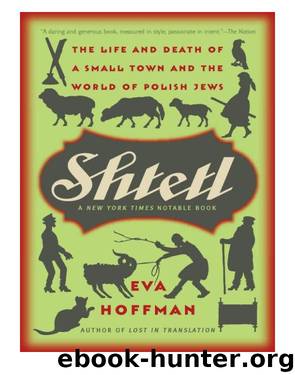
Shtetl by Eva Hoffman
Author:Eva Hoffman
Language: eng
Format: epub
Publisher: PublicAffairs
Published: 2011-03-01T05:00:00+00:00
In Brańsk, one Jew gave his life to the cause, a delicate youth who showed great promise as a scholar until he was recruited to fight in Warsaw. Sent to Siberia in the aftermath of defeat, he returned to town years later but could not recover from his terrible experiences, and died soon afterward.
“And so the Jews of Brańsk,” the Yizkor Book concludes, “learned what politics means.” But 1905, of course, was only one stage of the lesson. With the coming of the twentieth century, the layers of religious, cultural, and social insulation protecting the shtetl from the outside world had been punctured. From then on, the history of the shtetl was a story of its increasing penetration by that world. Between 1905 and 1914, change was peaceful but subtly decisive: those were the years of the shtetl’s meeting with modernity.
In the Jewish parts of Brańsk, public life gained new variety and stimulation. The Yizkor Book records, around that time, the creation of a library. This modest institution, located in the attic of a private house, was used by people of most classes and backgrounds. The clientele for novels was mostly female, and the works of Sholem Aleichem, who depicted shtetl life with vivid spontaneity and humor, were especially popular. Readers probably also came across the stories and essays of Y. L. Peretz, the dean of Yiddish writers in Warsaw, in whose later writing the shtetl already appears in a nostalgic and sentimental light, as a pastoral world of innocent goodness and piety.
There were other exciting developments. “From theaters they didn’t know in Brańsk,” the Yizkor Book observes. Still, in 1910 a group of youths “dared” to stage a Yiddish play, expressively entitled Shmendryks (Smart Alecks). Apparently the performance was a great success. A more permanent feature of the cultural scene was the phonograph, emitting its music through an enormous horn. During the summer, on their twilight walks, people stopped in front of the open window behind which this magical contraption stood, and listened to fashionable Yiddish songs. Occasionally, a mother whose son had emigrated discreetly wiped away a tear with her apron on hearing “Do Not Be Late with Mama’s Letter.”
But openness to the wide world had more profound effects: it shaped new kinds of lives — lives with enough movement, choices, and intersections with larger events to acquire the outlines of biography. In the Yizkor Book, one of the longest biographical sketches comes from the beginning of the century. It is the story of Lejb Jakub Freind, the son of a cantor and clearly a man of many parts and talents. Around 1900, Lejb Jakub studied in both well-known yeshivas and secular schools. He attended the Royal Conservatory of Music in Vilno, where he learned “the theory of singing,” and started writing for Hebrew journals. He was also fascinated by astronomy, and so impressed important scientists in his field that they nominated him for membership in the Royal Astronomical Society. Freind received a diploma in engineering, but when World War I broke out he made his way to Shanghai, where his life took yet more unexpected turns.
Download
This site does not store any files on its server. We only index and link to content provided by other sites. Please contact the content providers to delete copyright contents if any and email us, we'll remove relevant links or contents immediately.
| Africa | Americas |
| Arctic & Antarctica | Asia |
| Australia & Oceania | Europe |
| Middle East | Russia |
| United States | World |
| Ancient Civilizations | Military |
| Historical Study & Educational Resources |
Room 212 by Kate Stewart(5122)
The Crown by Robert Lacey(4817)
Endurance: Shackleton's Incredible Voyage by Alfred Lansing(4783)
The Iron Duke by The Iron Duke(4356)
The Rape of Nanking by Iris Chang(4213)
Joan of Arc by Mary Gordon(4112)
Killing England by Bill O'Reilly(4004)
Say Nothing by Patrick Radden Keefe(3986)
I'll Give You the Sun by Jandy Nelson(3447)
Shadow of Night by Deborah Harkness(3368)
Hitler's Monsters by Eric Kurlander(3343)
Mary, Queen of Scots, and the Murder of Lord Darnley by Alison Weir(3210)
Blood and Sand by Alex Von Tunzelmann(3205)
Eleanor & Park by Rainbow Rowell(3175)
Darkest Hour by Anthony McCarten(3133)
Margaret Thatcher: The Autobiography by Thatcher Margaret(3082)
Book of Life by Deborah Harkness(2939)
Red Famine: Stalin's War on Ukraine by Anne Applebaum(2934)
The One Memory of Flora Banks by Emily Barr(2863)
